I Just Wanted to Send Someone a Video
Recording your screen is free. Sending it to someone is what everybody charges for, with watermarks, five-minute caps, and a sign-in wall in front of the person you sent it to.
Half the messages I write would be better as thirty seconds of me talking over my screen. Not a meeting. Not a document. Just: here is the thing, here is what I mean, watch it whenever.
Your computer already does this. macOS records the screen. Windows records the screen. Your phone records the screen. The recording part has been free and built in for years.
The part nobody gives you is everything after you press stop.
The Charge Is Never for the Recording
Try to send that clip to someone. The file is 200 MB, so email rejects it. You put it in Drive and now they need permission. You use a proper tool instead and you meet the actual business model: a watermark across your face, a cap that cuts you off at five minutes, or a sign-in wall in front of the person you sent it to, who did not ask for an account. They asked for a video.
None of those limits exist because recording is expensive. Recording costs nothing. Your operating system does it for free. They exist because the recording is the hook and the sending is the product.
What actually costs money is storage and bandwidth. Keeping your files. Streaming them to whoever opens the link. That is a real, boring, per-gigabyte cost, and it is the only line item that scales with how much you use something.
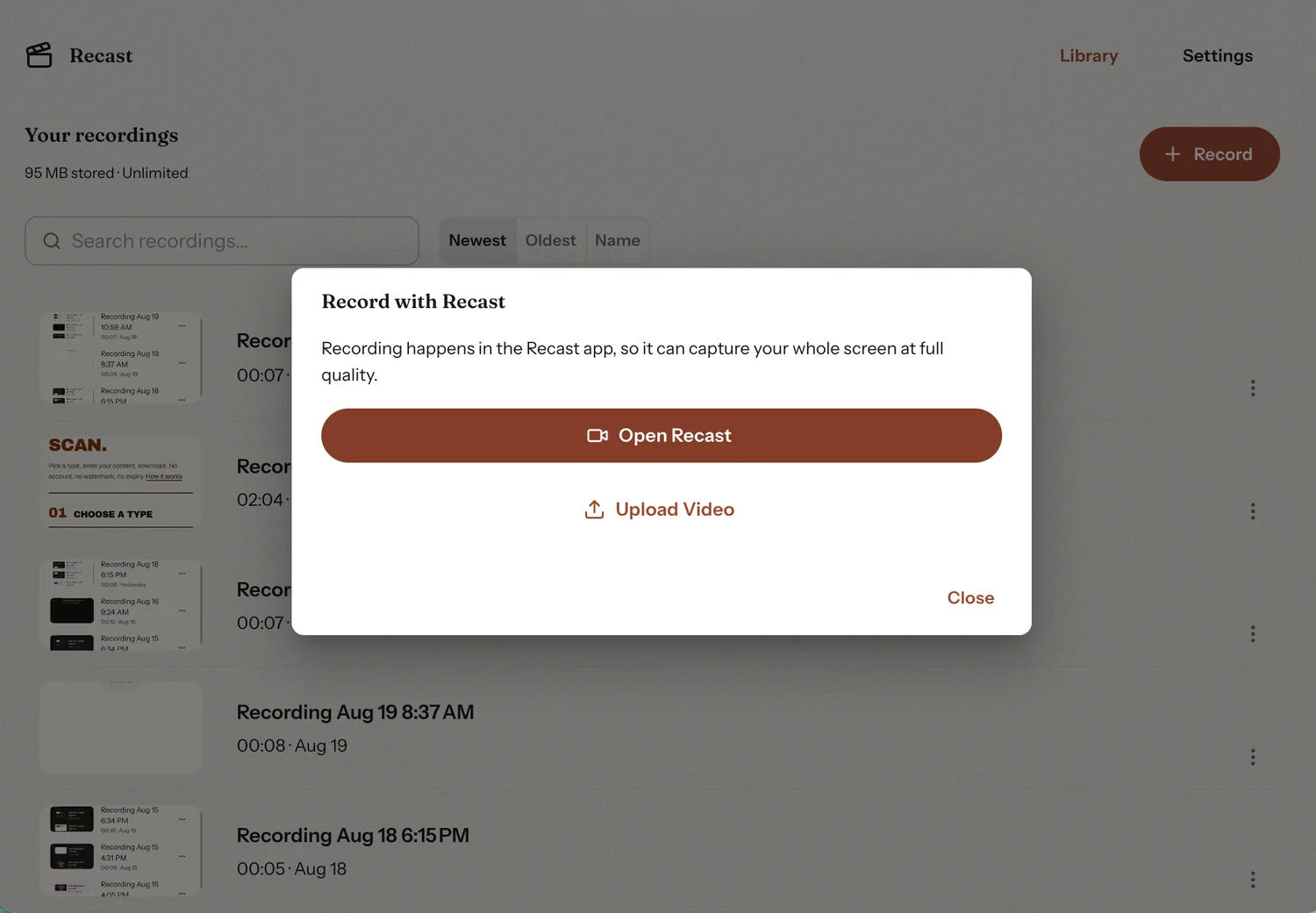 The Record button hands you to the native app or takes a file. There's no browser-capture fallback, on purpose.
So I Built the Version I Wanted
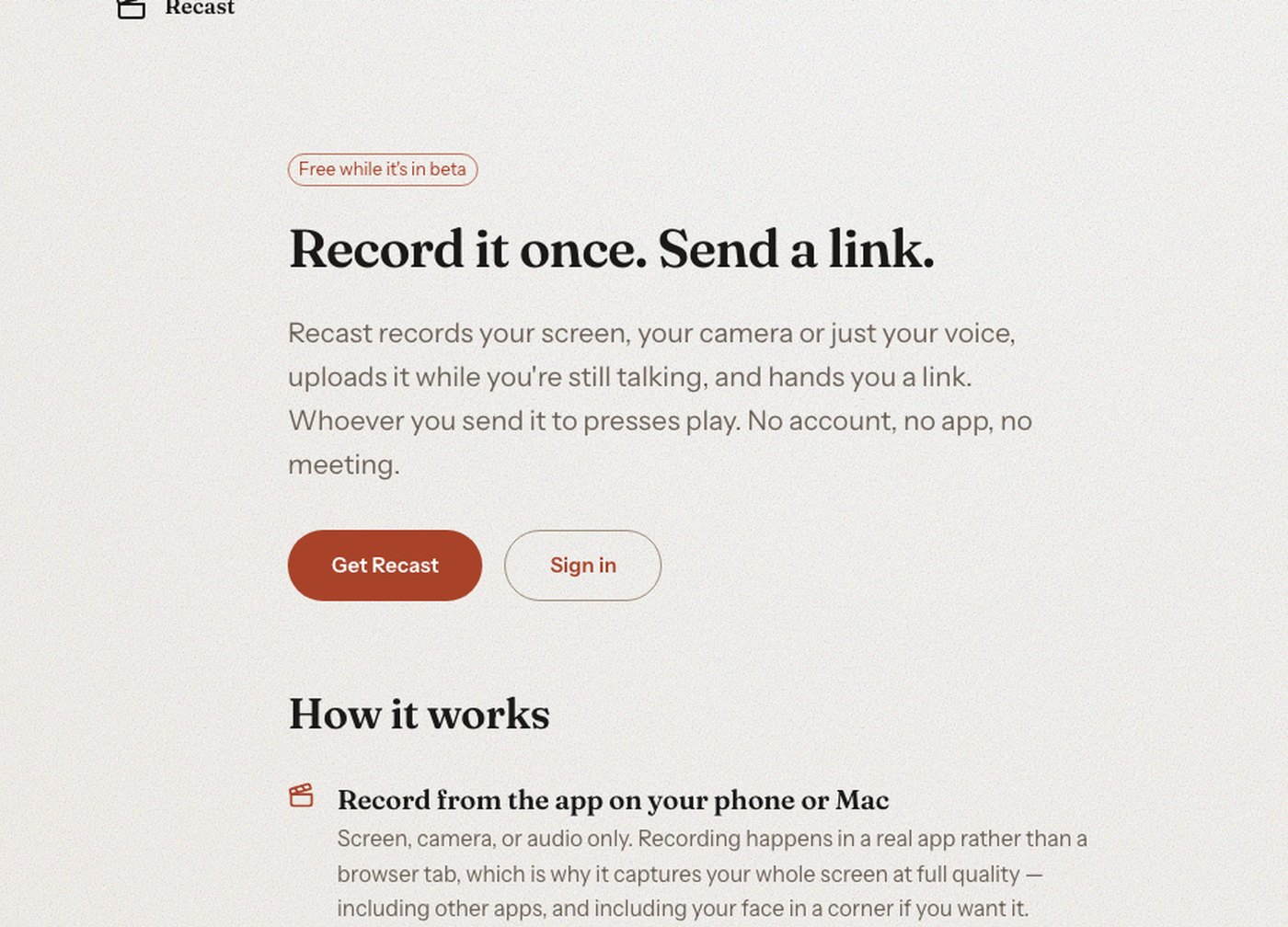
I made Recast because I wanted the convenience without the tax. It records on your Mac or your Android phone, uploads while you are still talking, and hands you a link. Whoever you send it to presses play. No account, no app, no meeting.
The pricing follows from that one idea: recording, sharing and downloads are identical on every plan, and nothing is watermarked. The only thing that changes is how much you can keep. Free gives you a gigabyte, which is about half an hour of video. Above that it is $9 a month for 50 GB, or $20 for 250 GB.
You are not paying to remove a watermark. You are not paying to record for six minutes instead of five. You are paying for storage, because storage is the thing that costs me money.
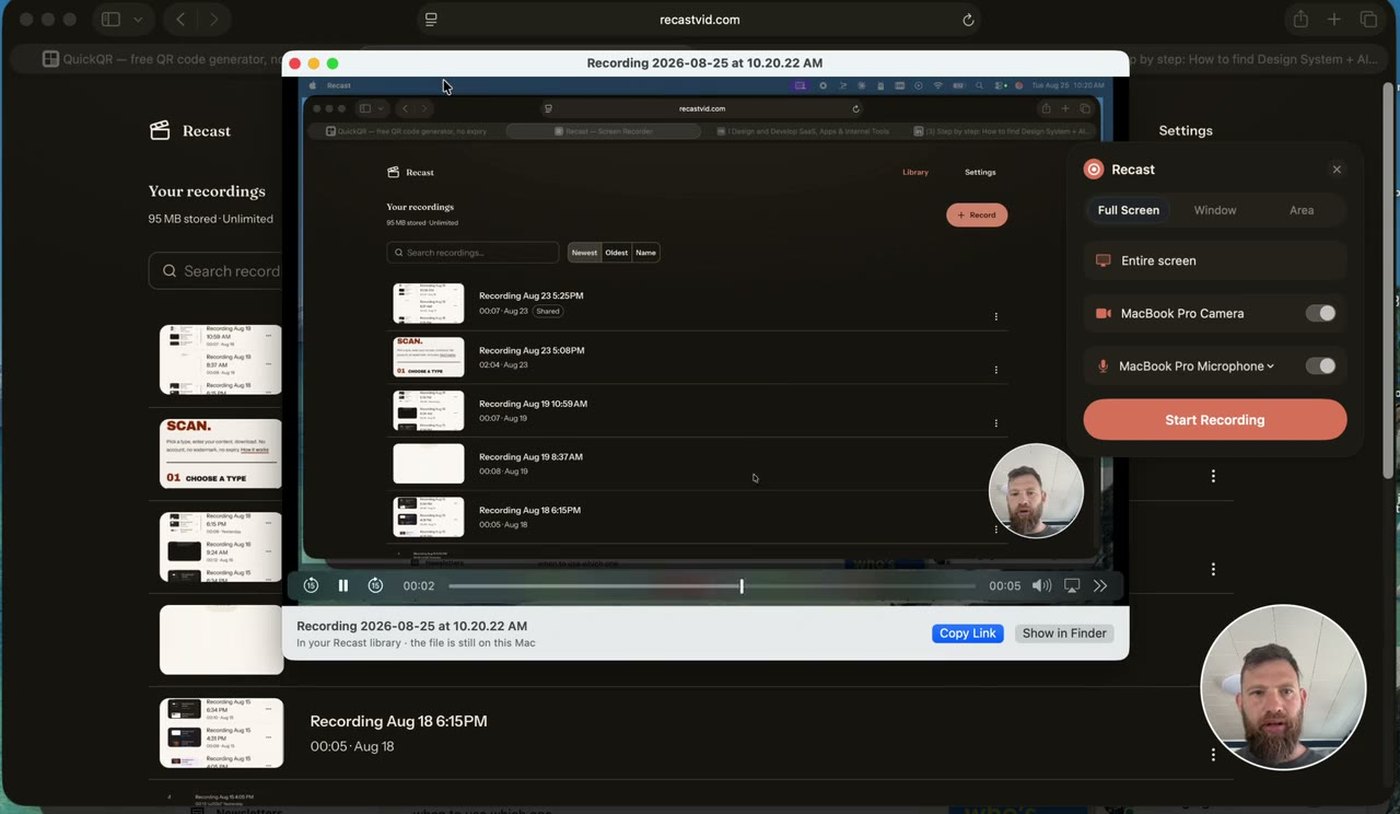 Press stop and the player opens on the local file immediately, share link already there. The upload happens behind it.
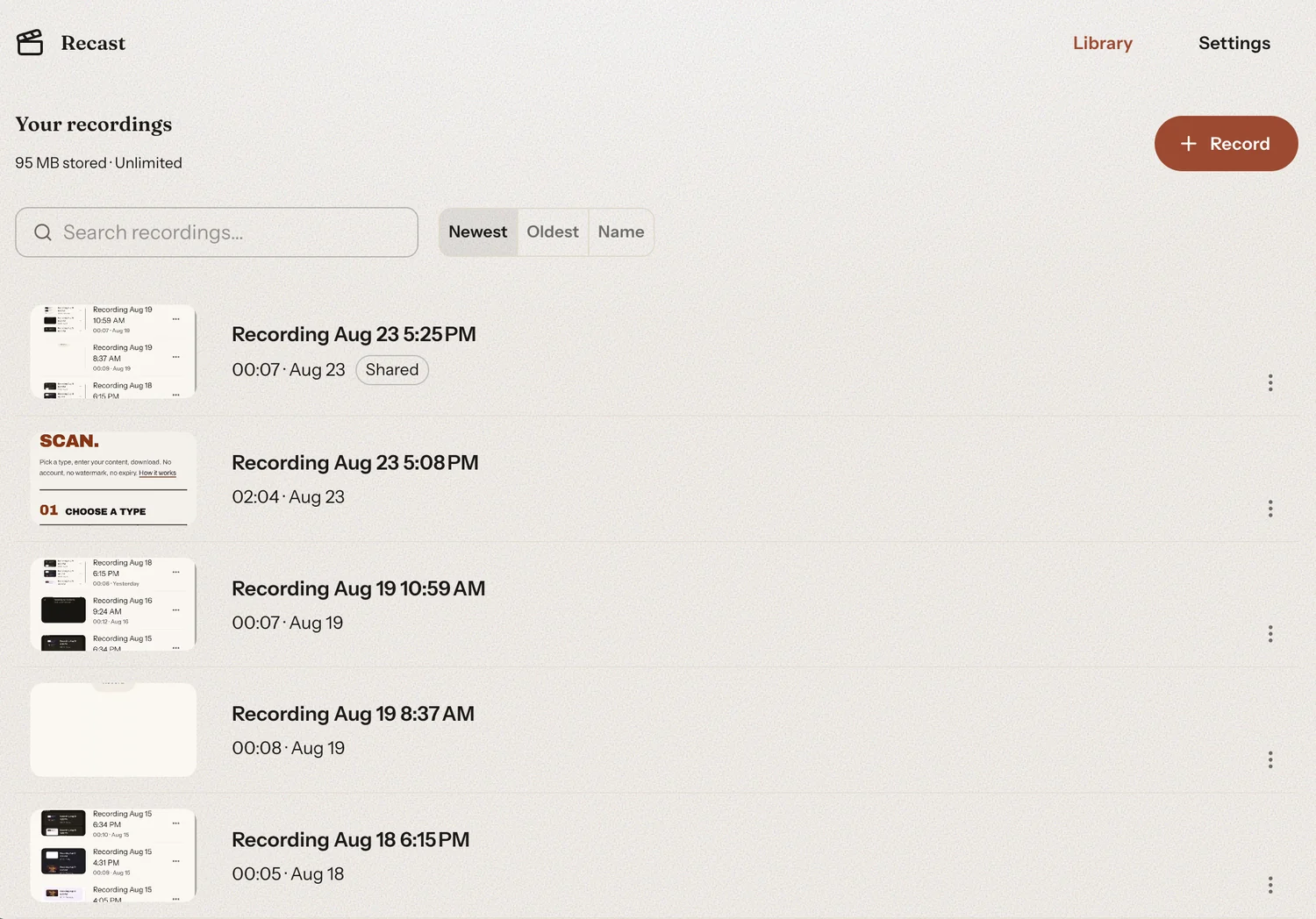 The other half of the boundary: the site stores and shares, and never records.
Convenience Is a Design Problem, Not a Feature List
The thing I cared most about is not on any pricing page. When you press stop, the video plays immediately, from the file already on your device, while the upload runs behind it. You are not watching a progress bar to find out whether the take was any good.
That sounds obvious. It is not what most tools do, and I know because I got it wrong in my own app first. The Mac version quietly waited for the whole upload before opening the player. On a fast connection you would never notice. On a plane you pressed stop and stared at nothing.
Offline still works now. The local file is the source of truth until the upload finishes. That is the actual convenience: the gap between finishing a thought and sending it is a few seconds, and nothing in the middle asks you for anything.
What It Is Not
It is not an editor. There is a trim, and that is deliberate. If you are cutting between takes and adding captions, you want a real editor and Recast is the wrong tool.
It runs on Mac and Android today. On iPhone you add it to your Home Screen and record with the iPhone's own screen recorder, and the upload and the link work the same way, but there is no native iOS app yet.
And it is one person's product. I designed it, built it, and I am the one who fixes it. That is the honest trade for the price.
The Test I Would Apply to Anything
When a tool charges you, look at whether the thing you are paying for is the thing that costs the company money. If the fee is for removing an obstacle they invented, a watermark, a timer, a login for your viewer, you are paying for the obstacle.
If it is for storage, bandwidth, or somebody's time, that is a real cost and a fair ask.
I built Recast on the second version of that. You can try it free and never pay me anything, and that is fine. A gigabyte covers a lot of thirty-second explanations.
Related UX Design Articles
The Work Is Deleting, Not Generating
AI made producing screens almost free. That moved the bottleneck from making things to deciding which ones to throw away, and no model will do that part for you.
When Trust Is the Product, It Can't Be a Feature
Getting two strangers to agree to meet at a park is easy. Getting them to feel fine about it's the entire product, and it's not something you bolt on near the end.
If You Make People Do Maths, They Guess or They Leave
A price of 67¢ tells you the odds are 67%. Almost nobody works that out in their head, and the ones who try get it wrong. Do the arithmetic for them.